
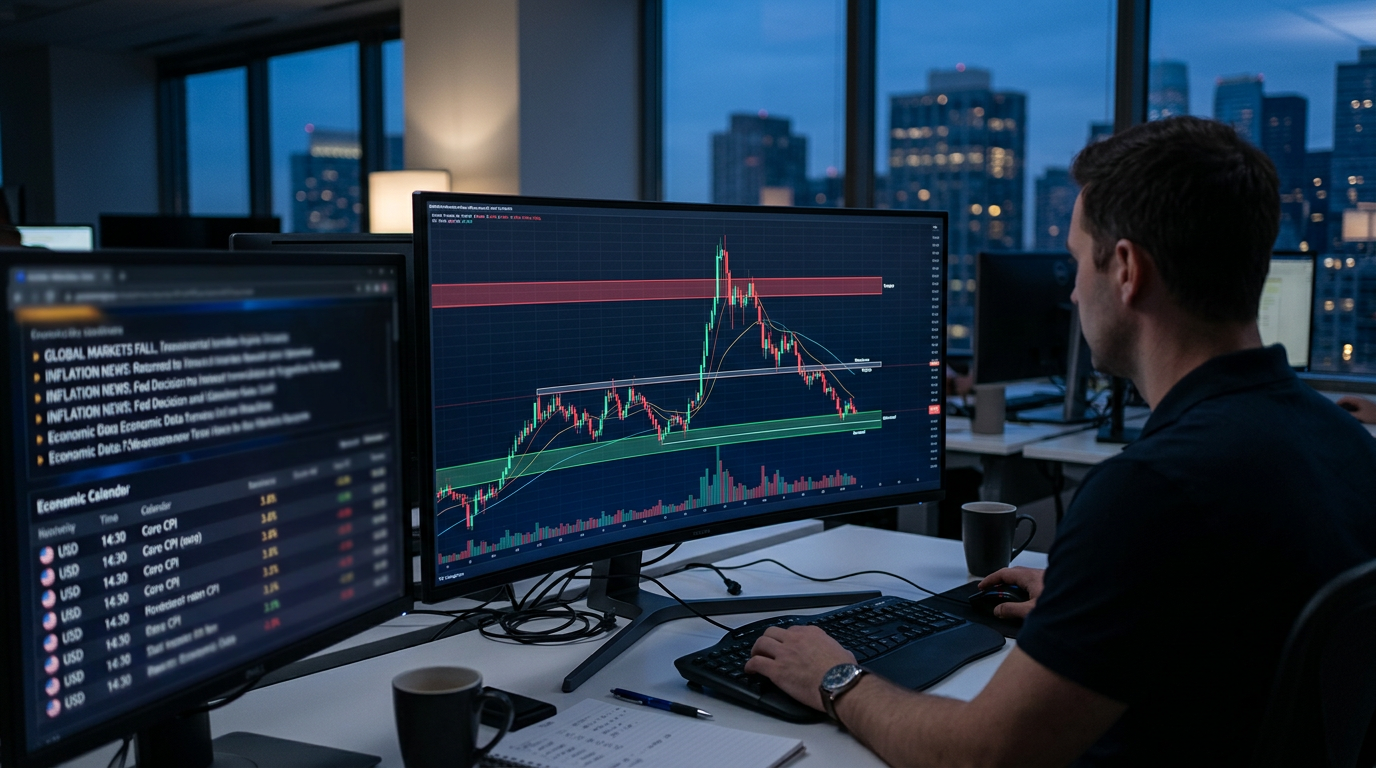
What You Will Learn
- Why news is the main reason zones fail
- How to rank releases by impact and adjust your risk
- The three ways to trade around a high-impact release
- A daily news routine that takes less than five minutes
Chapter 1: Why News Moves Zones
A supply or demand zone marks a price area where institutional orders were left unfilled. As long as the reason behind those orders stays valid, the zone tends to hold. News changes that reason. A hotter-than-expected inflation print or a surprise rate decision forces large players to reprice everything at once, and leftover orders get cancelled or overwhelmed.
That is why the same demand zone that held perfectly three times can collapse in a single candle at 8:30 AM New York time. The zone did not fail because it was drawn badly. It failed because the information that created it is no longer the information driving the market.
The liquidity gap problem
In the seconds around a major release, liquidity disappears. Spreads widen and price can jump over your stop instead of touching it. A 20-pip stop can turn into a 45-pip loss. Your position size is only correct if your stop actually fills where you placed it.
Chapter 2: Ranking News by Impact
Not every headline deserves the same respect. Sorting events into three tiers lets you keep trading your plan most of the time and stay careful only when it really matters.
High impact
- Examples
- CPI, NFP, central bank rate decisions, FOMC minutes
- How zones behave
- Can blow through fresh zones in seconds. Spreads widen, stops slip.
- What to do
- Stay flat 15-30 minutes before and after. Trade the zones the move creates.
Medium impact
- Examples
- PMI, retail sales, jobless claims, ECB/BoE speeches
- How zones behave
- Usually respects higher-timeframe zones but can wick through lower-timeframe ones.
- What to do
- Widen your stop buffer or reduce size if an entry lines up with the release.
Low impact
- Examples
- Housing data, minor sentiment surveys, secondary speakers
- How zones behave
- Rarely changes the structure. Zones behave as normal.
- What to do
- Trade your plan. Just be aware of the timestamp.
Chapter 3: Three Ways to Trade Around a Release
1. Step aside
Close or skip trades whose entry or stop sits close to a high-impact release. Being flat is a position, and often the most profitable one.
2. Trade the new zone
A violent news move leaves a fresh, strong base behind it. Wait for the dust to settle, mark the origin of the move, and trade the first pullback into it.
3. Use news as confirmation
If price is resting at a higher-timeframe demand zone and the data comes out supportive, the reaction confirms the zone. Enter on the lower-timeframe break of structure.
Worked example: a post-CPI demand zone
EUR/USD drifts lower into a 4H demand zone 20 minutes before US CPI. Entering here means your stop sits right where the release can spike through it. Skip the trade.
CPI comes in softer than expected. Price wicks into the zone, then rallies 60 pips in three candles. The base of that rally is a brand-new demand zone. The first pullback into it gives a clean entry with a logical stop.
Chapter 4: A Five-Minute Daily News Routine
You do not need to read the financial press all morning. You need to know three things before your first trade: what is scheduled, what already happened overnight, and which of your zones are exposed.
Check the calendar
Note every high-impact release for the currencies, indices, or coins you trade, with exact times in your timezone.
Read a short summary
Get a short recap of overnight headlines and the likely market impact. Skip the opinion pieces.
Flag exposed zones
Any zone you plan to trade within 30 minutes of a high-impact release gets a smaller size, a wider buffer, or a skip.
Get the summary on Telegram
The ChartLab-IQ Telegram bot sends a short market news summary every day, and you can ask for it at any time with /news or for a single asset with /news BTC. Each item includes its likely market impact and the source. Open the bot.
Conclusion: Respect the Calendar
Supply and demand zones show you where the orders are. News tells you when those orders can be overwhelmed. Traders who ignore the calendar blame their zones for losses caused by the clock. Rank releases by impact, step aside when the risk is unknown, and treat the violent moves news creates as a source of fresh, high-quality zones.
This article is for educational purposes only and is not financial advice. Trading involves substantial risk of loss.
Find the Zones News Creates
After a big release, ChartLab-IQ maps the new supply and demand zones in seconds, so you can trade the pullback instead of redrawing your chart.
Try ChartLab-IQ Free